
The Ultimate Guide to Gas Cylinder Safety
Key Takeaways:
- This guide treats handling and history as one subject. It moves from the hazards and daily floor habits to inspection and compliance under India's Gas Cylinders Rules, 2016, then closes with the piece most guides leave out, which is knowing what each cylinder has been through.
Gas cylinder safety is usually taught as a set of floor habits, like chaining cylinders upright and keeping the valve cap on until the moment of use. Those habits cover half the risk, because a careful handler can still pick up a cylinder that is two months past its test date, or one that came back from a customer with an unrecorded dent.
This guide treats handling and history as one subject. It moves from the hazards and daily floor habits to inspection and compliance under India's Gas Cylinders Rules, 2016, then closes with the piece most guides leave out, which is knowing what each cylinder has been through.
What are the key gas cylinder risks
Every cylinder carries two kinds of danger, the stored pressure that all of them share and the particular hazard of the gas held inside. Both shape the precautions in the rest of this guide.
Stored pressure: the hazard every cylinder shares
India's standard D-type cylinder packs about 7 cubic metres of oxygen into a steel shell of roughly 47 litres at around 150 bar, according to this USAID-supported operating procedure for oxygen cylinders, which is close to 70 times the pressure in a car tyre.
Should the valve snap off in a fall, that cylinder becomes a projectile. Non-flammable gases carry this risk too, and an April 2026 blast at a Dadra warehouse storing nitrogen and oxygen cylinders killed four people, News On AIR reported.
How the hazard changes with the gas inside
Beyond pressure, the contents decide what goes wrong in a leak, and the table below groups common industrial and medical gases by what happens when they escape. Medical and industrial oxygen share a row, since the gas behaves alike in a hospital store and a welding workshop.
Gas category | Common examples | Main hazard | Key precaution |
Flammable | Acetylene, hydrogen, LPG | Fire or explosion when a leak meets a spark | Store well apart from oxygen and ignition sources |
Oxidising | Oxygen, nitrous oxide | Makes oil, grease and clothing burn fiercely | Keep valves and fittings free of oil and grease |
Inert | Nitrogen, argon, helium | Displaces breathable air without any warning | Use and store only in ventilated areas |
Toxic or corrosive | Chlorine, ammonia | Harms the lungs and attacks valves | Check valves often and keep leak kits nearby |
Cryogenic | Liquid nitrogen, liquid oxygen | Cold burns, plus large gas volumes as the liquid boils | Wear a face shield and cryogenic gloves |
Table 1. Common gas categories and the main hazard each one brings to a plant or hospital store
Inert gases call for extra caution because the danger is silent. If one full 7 cubic metre nitrogen cylinder empties into a closed storeroom 3 m on each side, oxygen in the room can drop to around 16 percent, well under the 19.5 percent mark that OSHA treats as oxygen-deficient.
Any checklist can manage these hazards, provided the handler knows which gas is inside and what condition the cylinder is in, and those two facts come from the label and the cylinder's own record. Missing entries in either one leave the person at the valve guessing.
Labeling and identification
Cylinder contents should always be readable from a legible label or stencil on the shoulder, with colour serving only as a second check. Industrial and medical cylinders follow different colour schemes in India, and imports may carry another country's scheme, so a black or grey body alone can mislead a new hire.
Under Rule 8 of the Gas Cylinders Rules, 2016, industrial cylinders take fixed colours from IS 4379, and Rule 6 now adds a tamper-proof bar code on every cylinder, with QR codes and RFID tags accepted. Faded or damaged markings therefore count as a safety failure and a compliance failure at once, as a guessed gas can end up on the wrong regulator.
|
Best practices to handle gas cylinders safely
Cylinders injure people in two moments, when they fall while being moved and when gas escapes faster than expected at the valve. Sound gas cylinder storage and handling habits guard against both at a cost of a few seconds per cylinder.
Moving a cylinder from rack to work area
Falls tend to happen over the short stretch between a rack and a trolley, where people are tempted to tilt and roll a cylinder by hand. That stretch deserves as much discipline as a long haul across the yard.
Trolley for every move: Use a chained trolley even for a few metres, since Rule 18 of the Gas Cylinders Rules, 2016 prohibits sliding or dropping cylinders.
Cap on until use: Keep the valve protection cap screwed on whenever the cylinder is away from its regulator.
Grip the body: Lift by the cylinder body with two people or a cradle, and keep all load off the cap and valve.
Full until proven empty: Treat every cylinder as pressurised, including those tagged empty, as residual gas stays well above atmospheric pressure.
4. Opening a cylinder and fitting a regulator
At the valve, stored pressure meets the person, so the routine here stays slow and deliberate. Each step below assumes the cylinder is already chained at its point of use.
Stand to one side: Keep the cylinder body between you and the regulator, and open the valve slowly so the gauge rises gradually.
Oil-free oxygen fittings: Wipe oil and grease off oxygen valves and regulators, greasy gloves included, because pressurised oxygen can ignite them.
Matched protective gear: Wear safety glasses and leather gloves for routine work, and a face shield with cryogenic gloves for liquid containers.
Regulator off before moving: Remove the regulator and refit the cap before the cylinder goes anywhere, a vehicle included.
How to safely store gas cylinders?
A filled cylinder belongs upright and chained inside a ventilated, fire-resistant shed, well away from heat and open flames. These conditions come from Rule 21 of the Gas Cylinders Rules, 2016, while Rule 15(3) keeps cylinders out of high temperatures and direct sun.
Keeping cylinders upright and secured
Thin-walled cylinders such as LPG and dissolved acetylene must stand upright under Rule 21(3), and every other cylinder is safer that way too, chained at about two-thirds of its height to a rack that holds firm when a trolley knocks it. Since the Second Amendment of 5 June 2026, a Form F licensing authority can also allow taller stacking for industrial gas cylinders in certified racks or cages, once that permission is written onto the licence.
Separating gases by hazard class
Rule 21(4) keeps flammable and toxic gas cylinders apart from each other and from all other gases, by adequate distance or a suitable partition wall. Because the rule leaves the distance open, a useful benchmark is OSHA 1910.253, which keeps stored oxygen 6.1 metres from fuel gas or behind a non-combustible barrier 1.5 metres high with a half-hour fire rating.
Empty cylinders go in their own marked row with valves shut under Rule 21(7), and Rule 18(7) keeps mobile phones and open flames out of any area holding flammable gas. Cartons and oily rags belong outside the shed entirely.
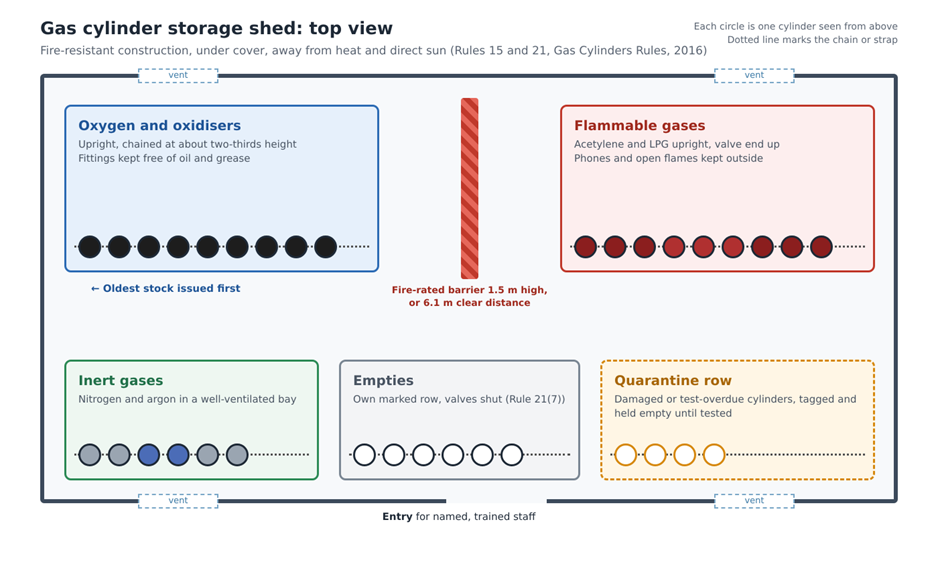
Figure 1. A storage layout that keeps oxygen and flammable gases apart and gives empties and quarantined cylinders rows of their own
Rotating stock and controlling access
Issuing the oldest full cylinders first keeps stock from sitting in the back row for a year while valves stiffen and labels fade. Access works best when limited to named, trained staff, and Rule 13 reserves loading and unloading for sober adults aged 18 and over. Inspect the store itself on a fixed schedule as well, as one rusted rack can topple a whole row of cylinders.
Transport safety
Cylinders on a vehicle face the same falls and leaks as cylinders in a shed, with road shocks and mixed cargo added on top. Gas cylinder transport safety in India starts with Rule 20 of the Gas Cylinders Rules, 2016, which points to Schedule VI for the conditions below.
Upright and strapped: Load cylinders upright with caps on, strapped down so none projects past the sides of the load bed.
Goods vehicles only: Schedule VI prohibits bicycles and other two-wheelers for any filled cylinder of compressed gas.
Separate loads: Send flammable gas cylinders separately from oxygen and other compressed gases, and keep toxic or corrosive cylinders away from foodstuffs.
Open bodies: Pick open-bodied or well-ventilated vehicles so a slow leak disperses, keeping cylinders out of closed vans and car boots.
Ramps over magnets: Choose ramps or tail-lifts for loading, because Schedule VI prohibits lifting magnets for filled cylinders.
Drivers need training of their own. Anyone driving a goods carriage with hazardous cargo, compressed gases included, must complete a three-day course at a state-recognised institute under Rule 9 of the Central Motor Vehicles Rules, 1989 and carry the endorsement on their licence.
What a missing endorsement cost one vehicle owner In M/s Chatha Service Station v. Lalmati Devi, decided on 8 April 2025, the Supreme Court treated a missing Rule 9 endorsement as a material breach after an oil tanker killed two people. The court let the insurer pay the claimants and recover the amount from the owner and the driver, as this case summary explains.
Fleet owners who hire contract drivers in peak months should check that endorsement before the first trip. Filing a copy of each endorsed licence with the trip sheet takes a minute and settles the question if an accident ever reaches a tribunal.
Inspection and maintenance
Two checks keep a cylinder fit for service, a quick visual look before each fill or use and a periodic hydrostatic test at a recognised testing station. Both have to happen on time for the cylinder to stay in legal circulation.
The pre-use visual check
Before a cylinder is filled or connected, someone should spend a minute checking the shell and valve for damage and confirming that the markings are readable. Brushing soap solution on the valve joint adds a few seconds and catches slow leaks that a gauge will miss.
What the check finds | What happens next |
Dent, bulge, gouge, corrosion or arc burn on the shell | Quarantine the cylinder and send it to a recognised testing station for assessment |
Bent, stiff or leaking valve | Move it to an open area, tag it and return it to the filler for valve repair |
Unreadable marking or missing bar code | Hold the cylinder until its identity is confirmed and it is re-marked |
Test date already passed | Hold it empty and tagged until it passes periodic testing |
Table 2. Common pre-use findings and the action each one calls for
Periodic testing under Rule 35
Filling is allowed only after a cylinder has passed a hydrostatic or hydrostatic stretch test within the interval IS 15975 sets for its type, or one the Chief Controller approves in writing, as Rule 35 requires. After testing, the recognised station stamps the date and its own mark on the neck, and our guide to the Gas Cylinders Rules, 2016 covers the intervals and record-keeping duties in detail.
Withdrawing a cylinder that fails or falls overdue
Once a cylinder fails its test, or loses more than 5 percent of its tare weight, Rule 36 has the testing station deface its markings and destroy it by flattening or cutting. An overdue cylinder deserves equally firm treatment until it passes, which means holding it empty and tagged in the quarantine row instead of filling it with extra care. Doing this across a few thousand cylinders spread over customer sites depends on someone tracking every due date, which is exactly what the law expects of a licence holder.
Compliance under India's Gas Cylinders Rules, 2016
PESO enforces these rules through licences, with Form E covering filling and Form F covering storage, both valid until 30 September of the year for which they were granted or renewed. Those licences rest on two running duties, periodic testing under Rule 35 and permanent marking under Rule 6.
Coded marking first became mandatory for high-pressure cylinders of non-toxic, non-flammable gases in January 2022, and G.S.R. 225(E) of 11 April 2025 extended a permanent, tamper-proof code to every cylinder, with code details due within 48 hours of a written notice. PESO followed up in February 2026, asking Form E and F licence holders to report their implementation status within 15 days.
Safety practice | Where the Gas Cylinders Rules, 2016 make it a duty |
Clear identification | Rule 6 for markings and the bar code, Rule 8 for colour |
Careful handling | Rule 18 |
Safe storage and segregation | Rule 21, with Rule 15(3) on heat and sun |
Road transport | Rule 20 and Schedule VI |
Periodic testing | Rule 35 |
Withdrawal of failed cylinders | Rule 36 |
Table 3. Everyday safety practices and the rules that make each one a legal duty
Seen this way, an overdue or unmarked cylinder is a physical hazard and a licence problem in the same breath. Plants that run safety and compliance as separate programmes end up checking each cylinder twice, and our Gas Cylinders Rules 2016 compliance guide has the full rule-by-rule detail.
The missing piece in most safety guides: a cylinder's history
Everything covered so far assumes the handler knows what the cylinder in front of them is, which holds only when that cylinder carries a reliable record of its fills and any damage reported along the way. When the record lives in a paper register or one supervisor's memory, a cylinder handled perfectly today can still be the one that came back from a hospital with a cracked valve guard that a driver mentioned only over the phone.
Paper logs are also easy to skip on a busy shift and easy to backfill later, which weakens the audit trail that safety depends on. Scanning a permanent ID at every movement ties the record to the steel itself, and CATalytics does this with a stainless steel ring carrying a scannable code, fitted to each cylinder's neck.
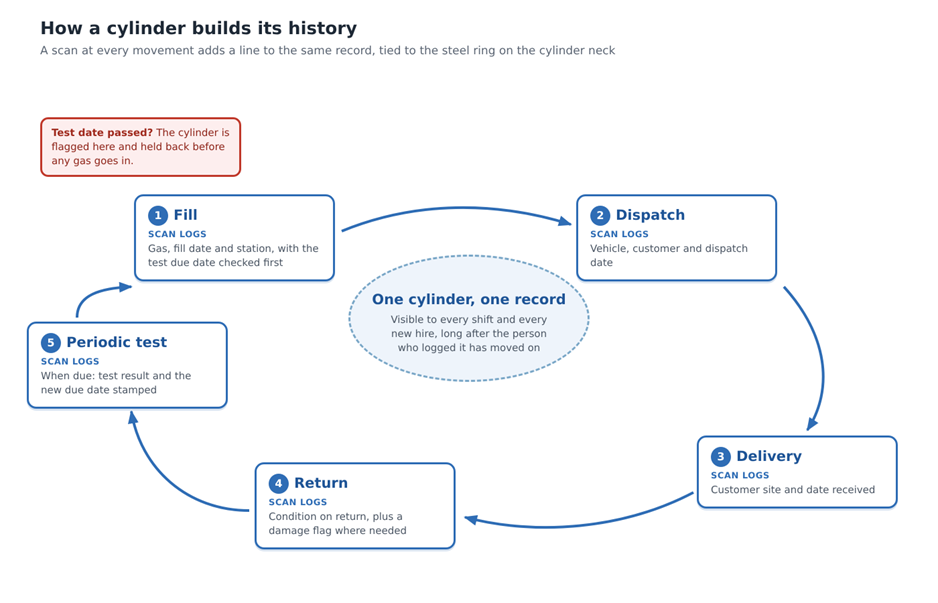
Figure 2. Each scan adds a line to the cylinder's history, and an overdue test date stops the cycle at the fill station
Scans at filling and dispatch, and later at delivery and return, all land in that cylinder's log along with any damage flag raised on the way. Cylinder test due date tracking is where this pays off most directly, because once a test date passes the system flags the cylinder at the fill station before any gas goes in, and again at dispatch.
Sticker labels peel and fade, and after a wash or repaint a sticker can end up on the wrong cylinder, quietly breaking the link between record and steel. A ring fitted at the neck stays with its cylinder through painting and rough handling, which is the point where a cylinder tracking ERP starts carrying the safety and compliance load.
Building a safety culture that sticks
Training fades fastest where people change fastest, since the habits taught at induction leave with each worker who moves on. An Aon survey reported by Business Today put attrition across Indian companies at 16.2 percent in 2025, so roughly one person in six on a typical site may be new within a year.
Systems hold on to what people forget, because a fill scan builds a log without anyone deciding to keep one and an automatic due-date flag works even on a new filler's first night shift. Checklists still earn their place, and a storeman asked to confirm that the rack holds zero overdue cylinders can answer in seconds when the scan data is already there.
Two questions to put to your cylinder records this week
Which cylinders on site or with customers are past their test date today?
Which cylinders came back damaged in the last month, and where are they now? If either answer takes more than a few minutes, a cylinder fleet audit is a sensible first step.
Gas cylinder safety comes down to handling and history
Keeping a cylinder upright and capped protects the people around it today, and a reliable record of its past protects the next person who opens its valve. CATalytics already tracks more than 2,00,000 cylinders for gas companies in India and the Middle East, building that record one scan at a time.
See how CATalytics supports cylinder safety and compliance and book a demo with our team.
Related posts
 Blog
The Ultimate Guide to PESO Approval
PESO is a central government body under the Department for Promotion of Industry and Internal Trade (DPIIT), and it controls how hazardous substances are stored and moved. Its head, the Chief Controller of Explosives, sits in Nagpur and works through nine Circle offices from Chennai to Guwahati.
 Blog
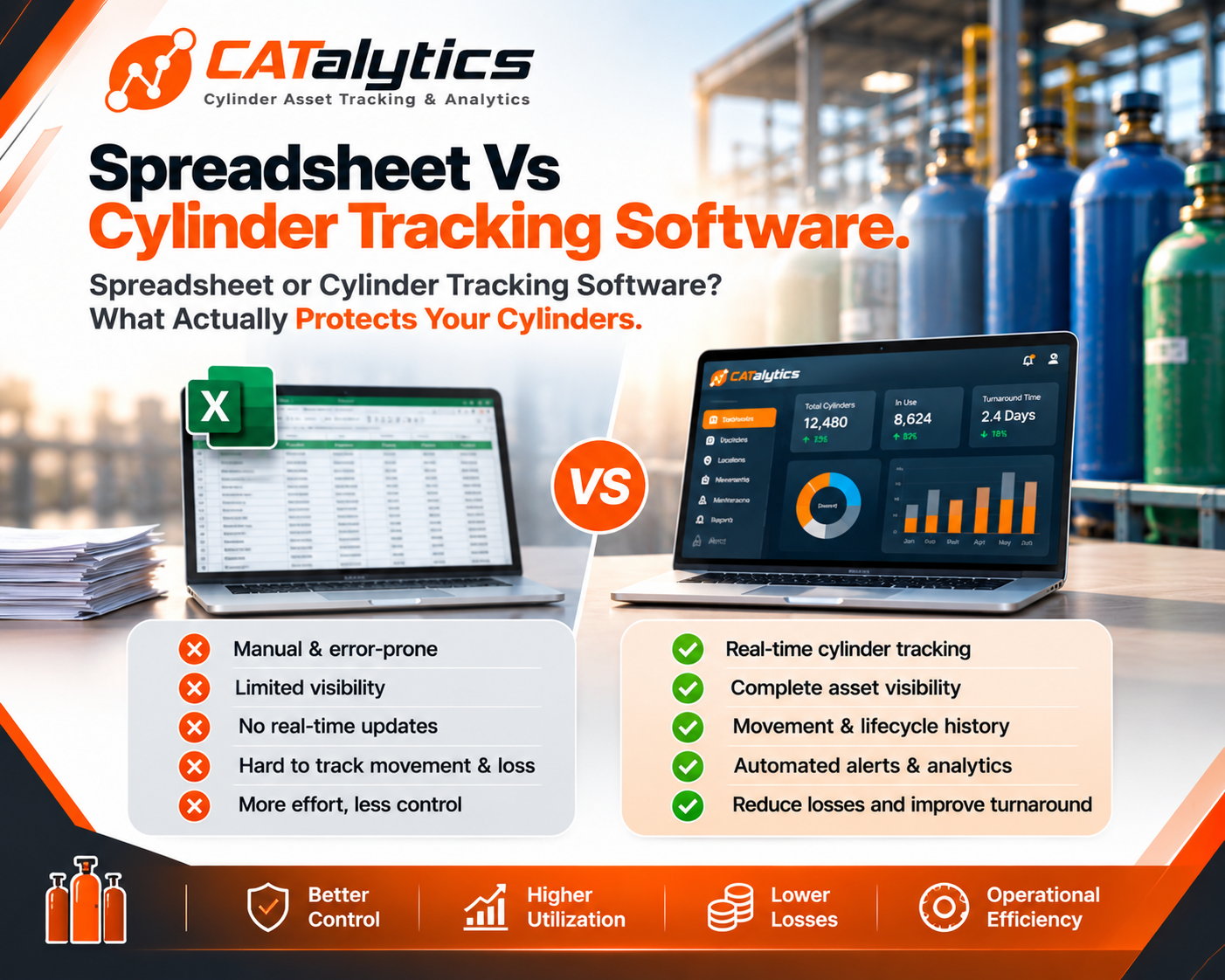
Spreadsheet or Cylinder Tracking Software? What Actually Protects Your Cylinders
Choosing between a spreadsheet and cylinder tracking software comes down to when the record is made. A sheet records a movement after someone gets round to it; tracking records the movement as it happens, from a ring on the cylinder, and everything else in this article, from demurrage to test dates, follows from that difference.
 Blog
Gas Cylinder Rules 2016: What Plant Managers Need to Know (Including the 2025 and 2026 Amendments)
This guide is written for the person who has to answer that inspector, which is why it gives the rule number and the date wherever one matters, so each claim can be checked against the gazette.