
Spreadsheet or Cylinder Tracking Software? What Actually Protects Your Cylinders
Key Takeaways:
- Somewhere in your customer base, there is a cylinder that went out eight months ago, stayed out, and is still missing from every invoice, because the person who could have flagged it was looking at a spreadsheet that still showed it as delivered and nothing more. Distributors comparing a spreadsheet with cylinder tracking software usually ask which tool is better, and that is the wrong question.
- A better question is whether the spreadsheet is tracking anything at all, or only recording what someone thought to type after the fact. What follows starts with why spreadsheets are the natural first tool and where they fail as a fleet grows, then sets out what dedicated software does differently, and ends with the cases where a spreadsheet is still the right answer.
Why gas distributors start with spreadsheets
Distributors start with spreadsheets for the same reason they start with a single truck, because it is what they have and it works on day one. Excel is already on the office computer, and a sheet with one row per cylinder takes an afternoon to set up.
At a few hundred cylinders, with one plant and one person keeping the sheet, the method holds up well. That person knows the customers by name and can walk to the yard to check a count that looks odd, so the sheet is backed by a memory that fills in what the cells leave out.
Any honest comparison has to start there, because the spreadsheet is a sensible choice at that scale, and the problems below arrive with growth, when the fleet outruns one person's memory.
Where spreadsheets break down as you scale
A sheet that worked for 300 cylinders starts to fail at 3,000 in two ways at once, as the entries fall behind the physical movements and the number of people typing into it multiplies the chances of a wrong entry. Both causes are behind each of the six breakdowns below.
The holding picture is always a week old
A spreadsheet shows where a cylinder was when someone last updated the row, which at most plants means the end of the week. A driver who delivers twelve cylinders to a machine shop on Tuesday afternoon and collects nine empties writes it on a delivery slip, and the slip reaches the office on Friday, if it reaches the office at all.
Until then, the sheet says the machine shop holds whatever it held last week, and any decision made on that number, from a dispatch plan to a customer reminder, rests on stale information. At one site that lag is a nuisance, and across sixty it is expensive.
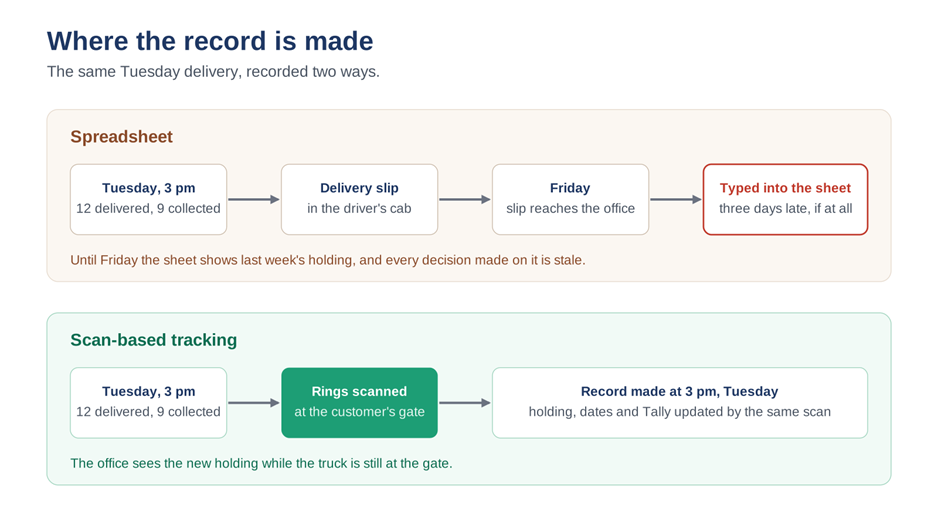
Caption: Where the record is made decides how old it is. A spreadsheet entry trails the movement by days; a scan is the movement.
Demurrage goes unbilled for want of a date trail
Demurrage is the holding charge a customer owes when a cylinder stays beyond the agreed return period, and billing it depends on proving the date the cylinder went out and the date it came back. A cell that anyone can edit, with every earlier value overwritten, proves neither date in a dispute.
That cost shows up as revenue that was earned and left off every invoice. A distributor with 2,000 cylinders at customer sites and a quarter of them past the return period has hundreds of billable holding periods running, and the sheet turns each one into an argument the customer will win.
Human error compounds at scale
A spreadsheet accepts 10432 typed in place of 10423 as readily as the right number, and a skipped row simply makes the list shorter, because the sheet treats every cell as free text. A 2024 review in Frontiers of Computer Science, led by Prof. Pak-Lok Poon, found that 94 percent of spreadsheets used in business decision-making contain errors.
One typing error in a fleet of 300 is caught by the person who knows the fleet. Spread the same rate across 5,000 cylinders and four people on different shifts, and the sheet gains mistakes faster than anyone can audit them out, with duplicate IDs and orphaned rows that nobody owns.
A worked example: A plant with 4,000 cylinders and four staff making 200 entries a day between them, at an error rate of one in every hundred entries, produces two wrong rows a day. After a quarter of 65 working days that is roughly 130 cylinders whose row says something the yard would contradict.
Spreadsheet and Tally drift apart
Stock in the yard lives in the spreadsheet, and stock in the books lives in Tally, and the two are reconciled only when somebody sits down to do it. Each delivery creates an entry in one and an invoice in the other, made by different people at different times, so the two totals part company a little further every week.
Reconciling them is nobody's favourite job, so it happens at year end, when the difference has grown large enough to need an explanation and old enough that the explanation is gone, and an auditor asking which figure is right gets two answers and a shrug.
Missing cylinders become write-offs
A cylinder that vanishes from a spreadsheet-run fleet takes its last known location with it, because the sheet records a customer name and a date, and both were typed in after the event. Its trail ends at whichever cell was filled in last, since the only entries were ever made at an office desk.
Lacking a last scan to point to, the follow-up call goes unmade and the cylinder moves to the write-off column at stock-take, where it joins the others. A cylinder fleet audit a year later confirms the gas cylinder loss and recovers only the knowledge of it.
Compliance and testing dates get missed
Every cylinder carries a periodic test due date, and under Rule 35 of the Gas Cylinders Rules, 2016 a cylinder past that date may be filled only after it has been retested. A spreadsheet holds the date in a column, and the column is checked when someone thinks to sort by it.
In a busy quarter nobody sorts by it, and cylinders stay in circulation past their test window until an inspector or a customer's safety officer reads a neck stamp. On paper the exposure is an inspection finding, and behind it sits the far larger exposure of a cylinder failing in service.
Read: RFID in Cylinder Tracking: Great Technology, Wrong Environment
What a dedicated cylinder tracking software does differently
Dedicated cylinder tracking software replaces the typed row with a physical identity on the cylinder and a scan at every movement, so the record is made at the moment the cylinder moves, by the person moving it. All six breakdowns above have a direct answer in that design, and the answers below are drawn from how CATalytics works.
Identity comes first, as a stainless steel ring carrying a unique code fitted to the neck of each cylinder, built to survive the handling a cylinder gets in a plant. Because the record is tied to that ring, a cylinder can be identified long after its paint and stencil have worn away.
What the ring replaces: A spreadsheet row is a description of a cylinder written by a person. As far as the software is concerned the ring is the cylinder, and every scan of it is a fact about where that specific asset was at a specific time. |
Movement comes next. Every handover is scanned, so the log builds itself and the office sees who holds which cylinder and since when, at any moment. Four scans do the work.
Scan at filling
Scan at dispatch
Scan at delivery to the customer
Scan at return
Those scan times are the date trail that demurrage billing was missing. Counting the days from delivery to return, the software measures each cylinder against the agreed period and flags the overdue ones by customer name with the dates behind them. An invoice for holding charges then rests on a scan record, and an overdue cylinder gets a follow-up call while it is still at a known address.
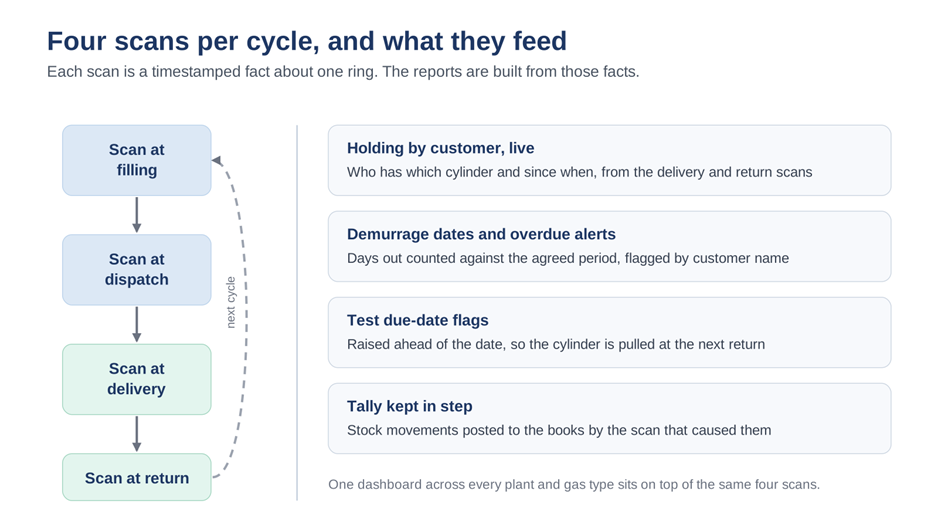
Caption: Four scans per cycle. Every report the office needs is built from them, with every entry made at the moment of the scan.
Syncing with Tally removes the second truth. Any scan that changes stock updates the books through the integration, so the yard and the ledger agree on their own, and an auditor gets one number.
Test due dates are held per cylinder against the ring, and the software raises a flag ahead of the date, so a cylinder approaching its test window is pulled at the next return instead of being filled. One dashboard covers every plant and every gas type, a view a spreadsheet offers only after six sheets have been copied into a seventh.
Spreadsheet vs. cylinder tracking software vs. Tally alone
Two of the options a distributor weighs are a spreadsheet and Tally on its own. Dedicated software with Tally connected is the third, and the table compares all of them on where the record is made and what it can prove.
A column for Tally on its own is there because many plants run on it alone, and it is excellent at the books. Its design stops at the ledger, which is why a Tally-only plant has accurate invoices and an unreliable picture of what sits at the customer's gate.
What you need | Spreadsheet | Tally alone | Cylinder tracking software with Tally |
Where the record is made | Typed later by office staff | Entered at invoicing | Scanned at each movement, by the person moving it |
Who holds a cylinder right now | As of the last update | Inferred from invoices | Live, by customer, with the date it went out |
Proof for demurrage billing | An editable cell | Invoice date only | Timestamped scans at delivery and return |
Entry validation | Absent | Ledger controls only | Ring code must exist; duplicates rejected |
Stock and books | Two totals, reconciled by hand | Books only | One total, synced |
Missing cylinder trail | Last typed entry | Last invoice | Last scan, with location and time |
Test due-date alerts | A column someone sorts | Absent | Flagged ahead of the date, per cylinder |
Multi-plant view | One sheet per plant | Per company | One dashboard across plants and gases |
How the three options compare on the questions a distributor actually has to answer.
When a spreadsheet might still be fine
A spreadsheet is still fine for a plant with a few hundred cylinders on a single site. It stays fine while the business sells cylinders outright and charges for the gas alone, so that holding periods stay out of the picture.
A simple test marks the tipping point. Ask the office who is holding your cylinders right now and how long each has been out, and time the answer; a plant that can reply in a minute from the sheet is fine, and a plant that has to ring two drivers and check a slip file has outgrown it.
Demurrage is where the test fails first, because a distributor who starts charging for holding periods is asking the spreadsheet for proof of dates, and a typed cell supplies a claim where proof is needed.
Moving off spreadsheets without disrupting operations
Moving off a spreadsheet takes days at most plants, because rings are fitted alongside normal filling and the old sheet keeps running until the last cylinder has been scanned in. Fear of a halted plant comes from ERP migrations, and this is a smaller kind of change.
Rings are fitted as cylinders pass through the yard, so a fleet comes onto the system in the order it returns for filling, and a cylinder that has sat at a customer for months is ringed when it comes back. CATalytics tracks more than 2,00,000 cylinders for gas distributors in India and the Middle East on this basis.
Tally stays where it is, with the software connected to it and keeping the books in step, so the accounts team keeps its tools while the change lands in the yard and the office, where the scanning happens.
What stays the same on the day you switch: Tally and the invoice formats carry on as before, and so do the drivers' routes. What changes is that each cylinder is scanned as it moves, and the record is made at that moment instead of at the end of the week. |
Tracked, or only recorded?
Choosing between a spreadsheet and cylinder tracking software comes down to when the record is made. A sheet records a movement after someone gets round to it; tracking records the movement as it happens, from a ring on the cylinder, and everything else in this article, from demurrage to test dates, follows from that difference.
If you want to see the difference on your own cylinders, book a demo and we will scan one of them and raise an overdue-cylinder alert for it on the spot.
Related posts
 Blog
Gas Cylinder Rules 2016: What Plant Managers Need to Know (Including the 2025 and 2026 Amendments)
This guide is written for the person who has to answer that inspector, which is why it gives the rule number and the date wherever one matters, so each claim can be checked against the gazette.
 Blog
How to Run a Cylinder Fleet Audit (Without Shutting Down Operations)
Most of a gas company's cylinder fleet is never inside its own gates. The cylinders are at customer sites, on trucks, at other plants, and in depots (sometimes where nobody has visited in months).
 Blog
Industrial Gas Cylinder Losses: Every Reason Your Filling Station Should Know
The structural problem with audit-driven loss control is one of cadence and resolution. Audits and physical counts find aggregate losses, after the fact, on a quarterly or annual cycle. Loss sources operate continuously, at shift level inside the gate and at transaction level outside it, every time