
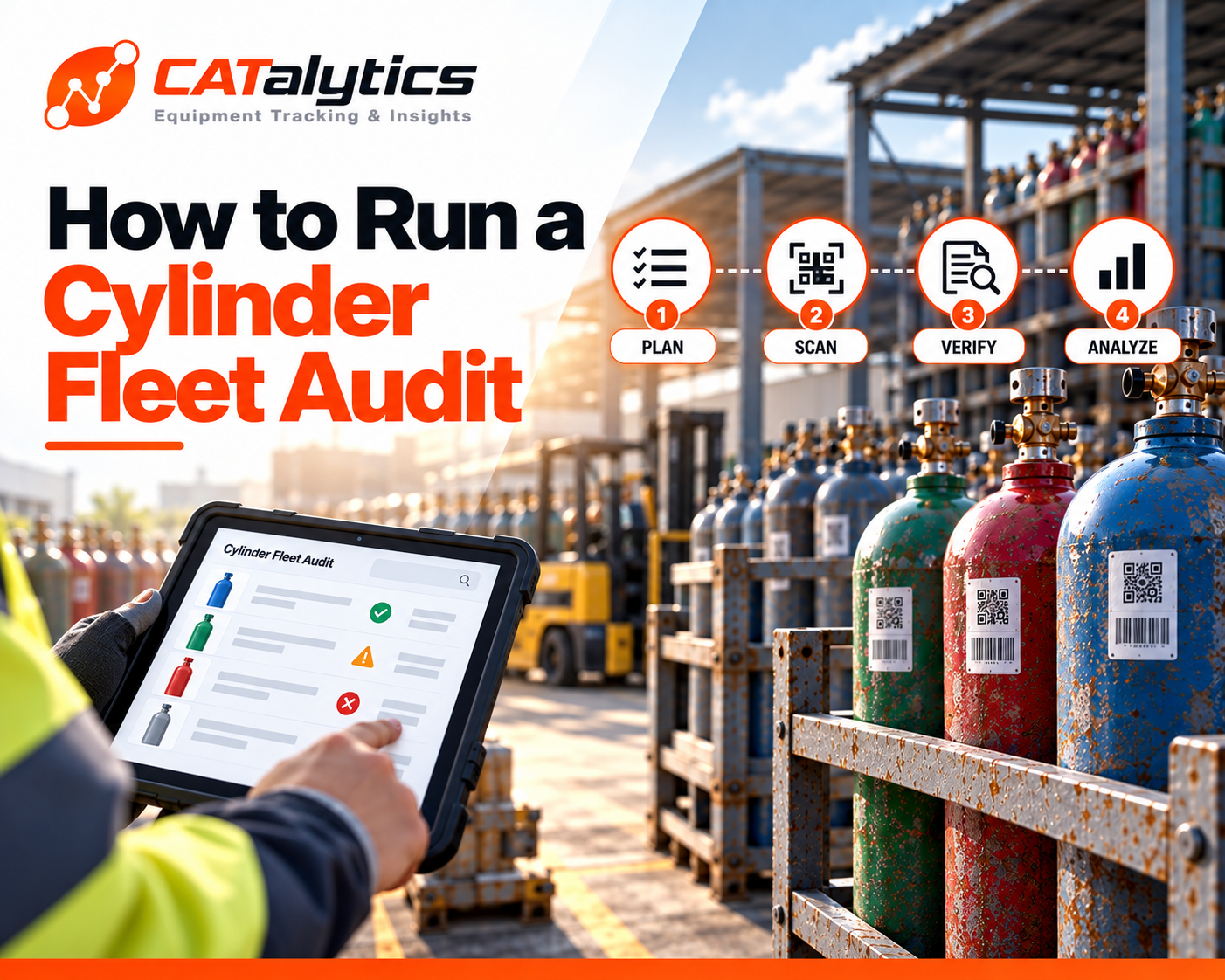
How to Run a Cylinder Fleet Audit (Without Shutting Down Operations)
Key Takeaways:
- Most of a gas company's cylinder fleet is never inside its own gates. The cylinders are at customer sites, on trucks, at other plants, and in depots (sometimes where nobody has visited in months). Each and every one of those cylinders is capital, and most companies do not know how much of that capital is missing until they go and look.
- The World Liquid Gas Association estimates that gas companies lose 10 to 40 percent of their cylinders every year, and most of that loss is never measured. It is absorbed as a cost of doing business.
- We are listing here a practical walkthrough for the plant manager or operations head who has to actually run the audit: what to prepare, what to count, how to reconcile against your books, how to handle the cylinders you cannot see, and what to do with what you find. The aim is an audit you can run without stopping filling and dispatch, and repeat next year without reinventing it.
Why Run a Cylinder Fleet Audit in the First Place
Finding lost cylinders is the obvious reason to audit, but there are three others that often matter more.
It finds the demurrage you are not billing: Cylinders held by customers past the agreed return period are revenue, and a surprising number of companies have no reliable list of who is holding what for how long.
It finds cylinders overdue for testing: Every cylinder has a test due date, and one that is still circulating past that date is a safety and compliance problem before it is anything else.
It finds the gap between your stock records and your accounts: The register says one number, Tally says another, and the yard says something else. Left alone, that gap becomes a year-end challenge to reconcile.
| Suggested reading: Common Causes of Industrial Cylinder Losses |
Conducting the cylinder fleet audit at the right time also matters. Most audits happen reactively, when a dispatch runs short or a customer disputes a balance, and by then the problem has had months to compound. An audit on a schedule, quarterly for a large fleet(5000+) or at least annually for a small one (1000-3000), catches problems while they are still cheap to fix.
Note: Step 2 is where most companies believe the audit ends. But an audit that sees through all 5 gives the full picture where customer holding also comes into account.
What to Prepare Before Starting a Cylinder Fleet Audit?
An audit goes wrong in the preparation more often than in the counting. Five things to have in place before anyone picks up a tally sheet.
Your baseline: Pull your last known stock position from wherever it lives: the cylinder register, your ERP, or Tally. Freeze it with a date and time. If you have more than one source, note what each says now; the differences between them are your first finding.
Your scope: Decide whether this is a full cylinder fleet audit or a spot check. A spot check of one plant, one gas type or one delivery route takes a day and tells you a lot. A full audit is the only way to get a fleet-wide number. First-time auditors usually do better starting small.
Your team: Assign three roles by name. Who counts, who reconciles the count against the books, and who signs off the findings. If one person does all three, the audit is only as reliable as that person's day.
Your customer-held records: Gather delivery slips, outstanding balances and any customer confirmations you have. This is almost always the weakest data in the company, so it deserves the most attention now. Note any disputed balances before the count, not during it.
Your timing: Choose a window that minimises disruption to filling and dispatch. The start of a shift, before trucks load, is usually quietest. Tell the dispatch team, so nobody moves cylinders out of a counted bay halfway through.
The Complete Step-by-Step Guide to Conduct a Cylinder Fleet Audit
Step 1: Count What Is Physically On Site
Walk the plant and the yard and count cylinders by gas type, splitting full from empty. Work bay by bay, mark each bay as done, and do not let anyone move stock out of a bay until it is marked.
While you count, flag three things separately from the total: cylinders with no valid test date visible, cylinders that are damaged, and cylinders you cannot identify at all. These do not belong in your usable stock number, and the third category is a sign that your identification system has gaps.
This is the step where method matters most. A manual tally sheet means counting, writing, adding up and then typing the result into a system, with a chance of error at every stage. Scanning a code on each cylinder as you pass removes the transcription and gives a count that already matches the system's identities. Whichever method you use, record the count with a date and time.
Step 2: Reconcile Against Your Books
Now compare the physical count with what the register, the ERP or Tally says should be on site. The two will not match. That is normal, and the point of the audit is the list of differences, not a matching total.
Document every discrepancy individually. Do not round gaps off, net a shortage in one gas type against a surplus in another, or decide a small difference is not worth recording. Small differences are how large ones start.
The common causes are not mysterious: transfers between plants that were never recorded, cylinders logged as returned that never came back to the yard, data entry that lags the movement by weeks, cylinders sent for testing and forgotten. For each discrepancy, write down the most likely cause. That is what you will fix in Step 5.
Step 3: Account for Cylinders at Customer Sites
This is the hardest step and the most valuable one. Most of the cylinders a company calls "missing" are not lost. They are sitting at a customer site, unaccounted for, because nobody has an accurate record of what went out and what came back.
Start from your delivery records and build, for each customer, the number of cylinders they should be holding by gas type. Then confirm it with the customer by a phone call, a visit, or a signed statement. Expect disputes, and expect to find customers holding far more than they think they are.
Flag every holding that is past your return or demurrage threshold. These are the follow-up calls that recover both cylinders and revenue.
There is a limit to what a once-a-year count can do here. A customer may have received and returned cylinders dozens of times since your last audit, and reconstructing that movement from delivery slips is slow and never complete. Without a continuous record of what each customer is holding, this step is an estimate, however carefully it is done.
Step 4: Check Compliance Status
While you have every cylinder in front of you, check its test due date. Do not make this a separate exercise later; it is the same walk, and the cost of doing it now is a few seconds per cylinder.
Any cylinder in circulation past its test window is a problem under the Gas Cylinders Rules, 2016, and it needs to come out of service until it is tested. Record each one by identity, not just as a count. If you are not sure what the rules require for your gas types, our explainer on the Gas Cylinders Rules covers it. [Link: Gas Cylinders Rules explainer]
Step 5: Close the Gaps
An audit that ends with a report has not finished. The findings need to become actions, and each action needs an owner and a date.
For customer holdings past threshold: a follow-up call, a demurrage invoice, or a collection, with a named person responsible for each customer.
For record discrepancies: corrected entries in the system, and a fix for the process that caused them, whether that is a transfer form nobody fills in or a return that is logged before the truck is unloaded.
For compliance findings: cylinders pulled from circulation and booked for testing, with the dates tracked.
This is the step most audits skip, and it is why the same gaps appear next year. By the time the count is done, everyone wants to get back to their real jobs. Assign the owners and deadlines anyway.
Finally, document the audit itself: the date, the scope, the method, the findings, and the actions. Next year's audit then has a baseline to compare against instead of starting from nothing.
Why Manual Cylinder Fleet Audits Are Hard to Repeat Consistently
Run the process above, and you will have a good audit. The difficulty is running it the same way next time.
A manual audit depends on who does it and how careful they are that day. Two teams counting the same yard will produce different numbers. The biggest blind spot, customer-held cylinders, cannot be fixed with a once-a-year count, because it is trying to reconstruct months of movement across different locations from manual paperwork. And because every audit is a special event, it competes with production for people and time, which is why it tends to happen only when something already feels wrong.
Scan-based tracking changes the shape of the problem. When each cylinder carries a scannable identity, a stainless steel ring fitted to the neck, and every movement is scanned at fill, dispatch, delivery, and return, the data that an audit normally has to rebuild already exists.
Where each cylinder is, who is holding it, how long they have had it, and when it is due for testing are visible continuously. The physical count and the system count use the same identities, so there is no separate reconciliation step between what is on paper and what is on the ground.
A formal audit then becomes a verification pass: walk the yard, scan what is there, and compare it with what the system already knows, in hours rather than days, without taking filling and dispatch offline. The ageing and turnaround reports surface the stuck cylinders that an audit is usually hunting for, without a special stock-take at all.
How Catalytics Can Help You Audit Less & Get Real-time Fleet Visibility
The aim is not to get better at running audits. It is to need them less, because the data is already real-time.
CATalytics, cylinder tracking software, tracks more than 2,00,000 cylinders for gas companies across India and the Middle East on exactly this principle: every scan is logged as it happens, holding and turnaround data is live, and an audit is a check against existing data rather than a reconstruction project.
If you are about to run an audit, or have just finished one that took longer than it should have, see how CATalytics turns every day into an audit, with live holding and turnaround data on demand. Book a demo today.
Related posts
 Blog
BlogIndustrial Gas Cylinder Losses: Every Reason Your Filling Station Should Know
The structural problem with audit-driven loss control is one of cadence and resolution. Audits and physical counts find aggregate losses, after the fact, on a quarterly or annual cycle. Loss sources operate continuously, at shift level inside the gate and at transaction level outside it, every time
 Blog
BlogRFID in Cylinder Tracking: Great Technology, Wrong Environment
RFID in Cylinder Tracking: Great Technology, Wrong Environment
 Blog
BlogHow to choose a Cylinder Inventory Management Software: The Complete Guide for Industrial Gas Distributors
Cylinder management software record the status & movement of cylinders, across all touchpoints. Each cylinder carries a unique ID, & every handover is logged.