
Gas Cylinder Rules 2016: What Plant Managers Need to Know (Including the 2025 and 2026 Amendments)
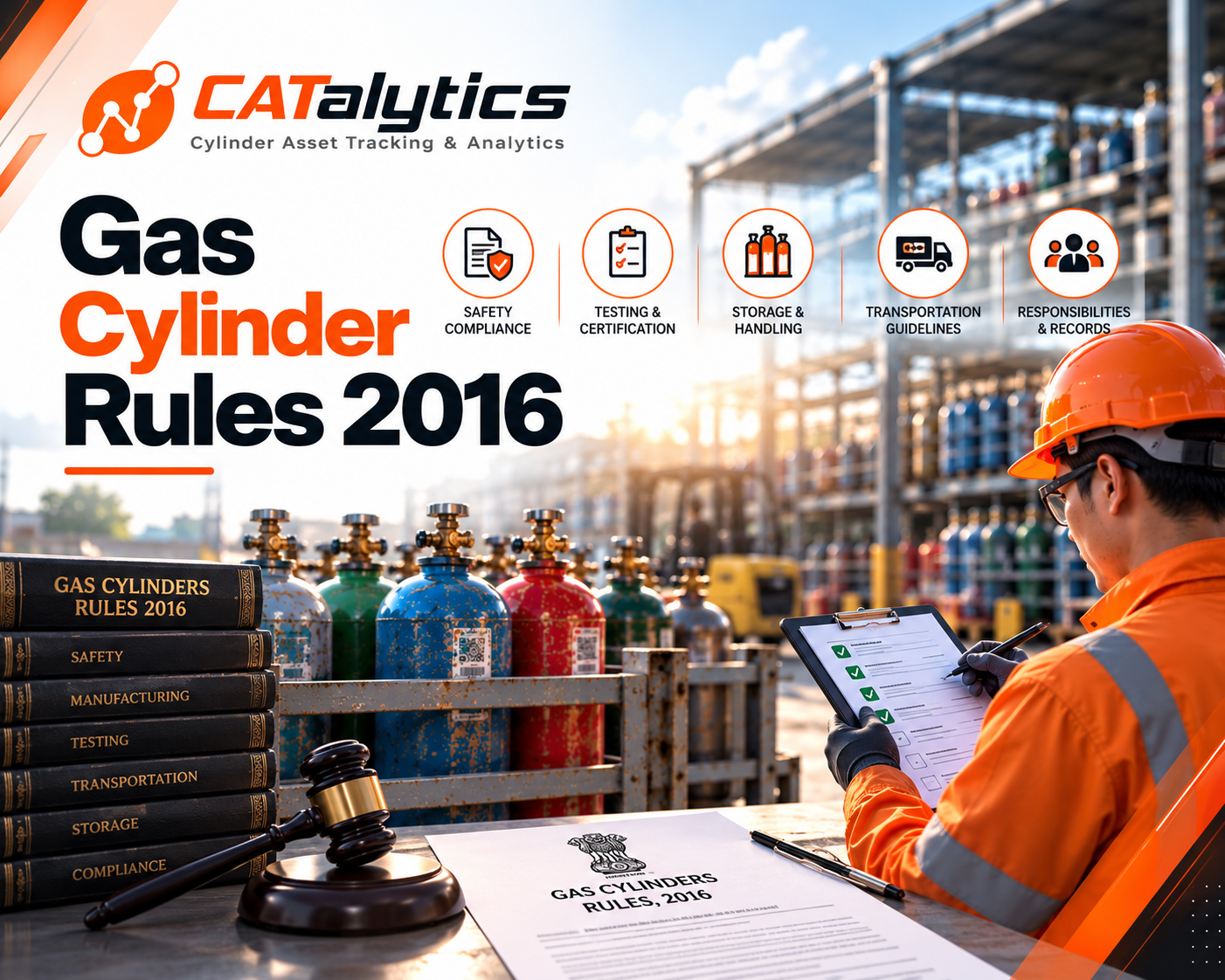
Key Takeaways:
- The gas cylinder rules 2016, are India's law for compressed gas cylinders, enforced by the Petroleum and Explosives Safety Organisation (PESO).
- A gas plant's filling and storage run on Form E and Form F licences, both of which expire on 30 September of the licensed year.
- Every cylinder has needed a permanent, tamper-proof bar code since G.S.R. 225(E) of 11 April 2025, and further amendments followed through 2025 and 2026, the latest on 21 September 2026.
A plant manager renewing a Form E licence in September [year] has to work from more than one document. The Gas Cylinders Rules, 2016 set out the principal duties, and later amendments changed several of them. PESO circulars and Indian Standards then add requirements of their own, and any of them can introduce a date or a document an inspector will ask to see.
This guide is written for the person who has to answer that inspector, which is why it gives the rule number and the date wherever one matters, so each claim can be checked against the gazette. It covers the licence that applies to a given activity and the records an inspector can demand, and it sets out what changed in 2025 and 2026, including the bar code mandate that PESO has been pressing the Form E and F licence holders on since February.
What are the Gas Cylinder Rules 2016?
Notified on 22 November 2016 under the Explosives Act, 1884, the Gas Cylinders Rules, 2016 replaced the 2004 rules, and PESO administers them under the Chief Controller of Explosives. They cover every stage of a compressed gas cylinder's life in India, from the day it is manufactured or imported to the day it is condemned, for gases as different as oxygen and CNG.
Whatever a PESO consultancy page says, the gazette text is the version that counts. PESO's own standard operating procedure says that where the SOP and the gazette differ, the gazette prevails, and PESO's rules page carries the principal rules alongside each amendment notification. A November 2025 amendment revised the definition of a gas cylinder, so a plant handling cryogenic containers or anything else near the definition's edge should read the current wording before assuming it is out of scope.
Who the rules apply to
Every business that handles compressed gas cylinders for trade falls under PESO’s rules. The licence each business needs depends on what it does with them. In practice, this means the business is pursuing one of the following operations:
• Filling plants that fill cylinders with compressed gas
• Storage sheds and godowns that hold filled cylinders for sale
• Importers of cylinders and valves
• Cylinder testing stations recognised by PESO
• CNG and compressed biogas dispensing stations
• Anyone holding filled cylinders beyond the small exemption quantities
Companies that store cylinders in bulk sit under a separate set of rules. Under the Static and Mobile Pressure Vessels (Unfired) Rules, 2016, a liquid oxygen tank behind the filling bay, or the road tanker that feeds it, is classified as a pressure vessel. A plant that runs both a tank and a cylinder operation holds two licences and answers to two inspection regimes.
What are Forms D, E, F and G?
Of the seven forms attached to the rules, only Forms D to G are licences. Form A is a declaration for a ship carrying cylinders, and Forms B and C are the applications you file to obtain a licence or to renew one.

Forms A to C are declarations and applications. The licences are D, E, F and G.
Licences are tied to an activity and to a granting authority, and the authority depends on the gas. Toxic and flammable gases go to the Chief Controller of Explosives at Nagpur, while non-toxic, non-flammable gases such as oxygen and nitrogen go to the regional PESO Circle office.
Form | What it licenses | Who grants it |
Form D | Import of cylinders into India | Chief Controller of Explosives |
Form E | Filling cylinders with compressed gas, and possession of filled cylinders for sale | Chief Controller of Explosives at Nagpur for toxic or flammable gases; the PESO Circle office for non-toxic, non-flammable gases |
Form F | Storing filled cylinders for sale or supply, for a dealer or depot that buys cylinders already filled and only stores and sells them | Same split as Form E |
Form G | Dispensing CNG or compressed biogas into vehicles | Chief Controller of Explosives |
The four licences under the Gas Cylinders Rules, 2016, with the authority that grants each.
Which licence do you need to fill cylinders?
To fill cylinders with any compressed gas you need a Form E licence under Rule 43, and the same licence covers holding the filled cylinders for sale. A dealer or depot that buys cylinders already filled and only stores and sells them needs a Form F licence instead.
So the question to ask is whether your business fills cylinders or simply holds them. An oxygen plant deals with its Circle office either way, and the same plant adding acetylene deals with Nagpur.
Validity, renewal, amendment and transfer
Validity runs to 30 September of the year for which a Form E or F licence was granted or renewed, and Rule 51 allows each to be granted or renewed for up to ten years at a time, which is why renewal questions cluster in the weeks before that date. A licence allowed to lapse puts every fill after 30 September outside the law, so the renewal filing belongs in the plant calendar months ahead.
Renewal goes through the PESO portal, where every application is now filed online, using Form C with the Schedule V fee and the supporting papers, which include proof that you still hold the land and an undertaking that no litigation is pending on the premises. PESO's SOP lists a Form E fee of ₹5,000 per gas type, and a December 2024 draft proposed lower fees for small enterprises and startups, among others, so confirm the current table before paying.
Three further rules shape the licence calendar, and each one creates a date to track.
Rule 50: the licence is endorsed after inspection, so an inspection visit is part of keeping the licence alive
Rule 53: alterations to the licensed premises need prior approval, which catches the plant that extends a shed and tells PESO afterwards
Rule 54: amendment and transfer go through PESO, so a change of ownership or company name is filed there before it is recorded anywhere else
Renewal calendar: Form E and F licences expire on 30 September. File the Form C renewal through the PESO portal well ahead of that date, and keep the Rule 50 inspection endorsement on the licence itself. A Rule 53 alteration goes in for approval before the work starts.
Cylinder standards, testing and records: What inspectors look for
Inspectors at a filling plant look at two things before anything else, the markings on the cylinders in the filling bay and the records behind them. Stamped on the neck, the test date shows whether a cylinder is inside its period, and Schedule IV sets out the test record that should match it.
Approved cylinder and valve standards
Schedule I names the Indian Standards a cylinder or valve must be made to, and PESO approves both the design and the manufacturer before a cylinder can lawfully be filled. For an industrial gas plant the standards that come up most are IS 7285 for seamless steel cylinders and IS 3224 for industrial gas cylinder valves, with separate standards for welded cylinders and for dissolved acetylene.
Approved manufacturer lists run to many pages and change often, so the useful habit at plant level is to read the cylinder's own markings on receipt. Those markings should identify an approved standard and maker, and the valve fitted should be the one specified for the gas.
Plant-floor check: Pull five cylinders at random from the filling queue and read the neck stamps against the test interval in IS 15975 for that cylinder type. A cylinder past its date in the queue is a Rule 35 breach waiting for the next fill, and it is the easiest finding an inspector can make.
Periodic testing (Rule 35)
How often must gas cylinders be tested? Rule 35 permits filling only where the cylinder has passed a hydrostatic test, or a hydrostatic stretch test where the cylinder type requires one, within the period laid down in IS 15975 or as the Chief Controller of Explosives approves. Because the interval depends on the cylinder type and the gas, the standard itself is the authority for each type, and PESO's own FAQ gives ten years for LPG cylinders as one example.
At the testing station, the test date and the station's mark are stamped on the cylinder neck, and the same station records each test in the format Schedule IV prescribes. A cylinder that fails the test is condemned, as is one that has lost more than five percent of its original tare weight, and a condemned cylinder is withdrawn from service for good.
Records you must keep
Records under the rules are kept per cylinder for the most part, and each has a rule or schedule behind it that an inspector can cite when asking for it. Five of them come up at every inspection of a filling or storage plant, and the table sets them out.
Who keeps each record matters as much as its contents, because the rules split the duty between the testing station and the owner, with the filler holding its own filling and conversion records. Any of the three can be asked, and a mismatch between their copies is itself a finding.
Record | Where it comes from | Who keeps it |
Test history for each cylinder, including owner, serial number, each test date and pressure, water capacity, tare weight and valve type | Schedule IV | The testing station and the cylinder owner |
Conversion records when a cylinder is changed from one gas to another | Rule 28 | The filler and the owner |
Verification of ownership before filling at high-pressure filling premises | PESO order on high-pressure cylinders | The filler |
Bar code details for every cylinder, in physical and digital form, within 48 hours of a written notice | Rule 6, as amended by G.S.R. 225(E) | The licence holder |
Filling records showing each cylinder filled, with the gas and the date | Form E licence conditions | The filler |
The five cylinder-level records an inspector asks for, with the rule behind each and the party responsible.
All five are manageable for a few hundred cylinders in a register, and each turns into a different kind of work once the fleet runs to thousands spread across customer sites, with test dates falling due on different days and conversions happening between visits.
Storage, filling and transport requirements
Storage sheds
A storage shed for filled cylinders must be built of fire-resistant materials and kept cool, with combustibles kept out and incompatible gases kept apart. For toxic and flammable gases other than LPG, PESO's SOP adds a clear distance of three metres around the storage and an industrial fence two metres high.
Shed layout, including gangways and stacking heights, forms part of the licence drawing, which is why a change to any of them is an alteration under Rule 53. Condition 8A, added to Form F by the Second Amendment of June 2026 (G.S.R. 447(E)), lets the licensing authority permit higher stacking and narrower gangways for industrial gas cylinders held in certified racks or cages, a concession a crowded depot can use once the permission is written onto the licence.
Filling limits
Filling limits come from the cylinder itself. A cylinder may be charged only to the working pressure and filling ratio for which it was designed and tested, and the rules leave those figures to the cylinder standard and the gas. At the manifold, pressure is set from the cylinder marking, and a cylinder whose test period has lapsed is set aside before it reaches the manifold.
Transport (Schedule VI)
Schedule VI's conditions for moving cylinders are specific enough to check on every dispatch.
Two-wheelers are excluded from carrying cylinders
Valves are protected by caps or guards while in transit
Flammable gases travel apart from other compressed gases
Toxic or corrosive gases travel apart from food
Lifting is by cradle or sling, and magnets are prohibited
Consignment notes should let each cylinder be traced back to its filling record, which is also the document an inspector will ask for when a cylinder turns up somewhere it should be absent.
Gas Cylinders Rules amendments: a dated timeline, 2016 to 2026
Amendments to the Gas Cylinders Rules, 2016 are listed below by date and gazette number, from the principal notification to the Third Amendment of September 2026. Pages that currently rank for this subject give the amendments without dates or numbers, and the latest change they cover is April 2025.
Show Image
Ten years of amendments to the Gas Cylinders Rules, 2016. The pace picked up sharply in 2025.
Drafts are marked as drafts, because a draft notification invites objections and takes effect only when the final rules appear in the gazette. Where a row says to check the text, the amendment made changes outside the scope of this guide and the gazette entry is the place to read them.
Date | Instrument | What changed | Who it affects |
22 Nov 2016 | G.S.R. 1081(E) | Principal Gas Cylinders Rules, 2016 notified, replacing the 2004 rules | Everyone |
2018, 2019, Jan 2022 | Amendments up to G.S.R. 44(E) | Earlier amendments listed in PESO's SOP | Check the SOP for your activity |
Dec 2024 | Draft | Proposed reduced fees for small enterprises, startups and women entrepreneurs | Licence applicants |
11 Apr 2025 | G.S.R. 225(E) | Permanent, tamper-proof bar code on all cylinders and cryogenic containers; 48-hour disclosure; fill block for fuel gases | All licence holders, fillers and traders |
28 Jul 2025 | G.S.R. 501(E), Third Amendment 2025 | Further amendments to the principal rules | Check the text for your activity |
12 Nov 2025 | G.S.R. 839(E), Fourth Amendment 2025 | Revised definition of "gas cylinder" | Plants handling cylinders near the definition's edge |
3 Feb 2026 | Draft | Proposed relaxations for cylinder imports | Importers |
5 Feb 2026 | PESO circular | Form E and F licence holders to report bar code implementation status within 15 days | Form E and F licence holders |
5 Jun 2026 | G.S.R. 447(E), Second Amendment 2026 | Rule 48 omitted and the matching Form C document removed; Form F condition 8A allows higher stacking and narrower gangways for industrial gas cylinders in certified racks or cages | Licence applicants; industrial gas depots |
15 Jul 2026 | PESO circular | Manufacturers and importers to confirm bar code compliance by 31 July 2026 | Manufacturers and importers |
21 Sep 2026 | Gas Cylinders (Third Amendment) Rules, 2026, in force 23 Sep 2026 | Framework for CNG and compressed biogas mobile refuelling units | City gas distributors; Form E and F licensees running CBG units |
Amendments and PESO circulars from the 2016 notification to September 2026, with gazette numbers where the instrument is final.
The bar code mandate (G.S.R. 225(E))
Is bar coding mandatory on gas cylinders in India? Bar coding has been mandatory since the Gas Cylinders (Amendment) Rules, 2025, notified as G.S.R. 225(E) on 11 April 2025, when Rule 6 began to require a permanent, tamper-proof bar code at a conspicuous place on every cylinder and cryogenic container used for filling compressed gases and liquids, and the licence holder must produce the bar code details within 48 hours of a written notice.
Cylinders already in circulation were given 365 days to be marked, a window that closed in April 2026. PESO's circular of 5 February 2026 asked Form E and F licence holders to report their implementation status within 15 days, and a second circular on 15 July 2026 gave manufacturers and importers until 31 July 2026 to confirm compliance.
Scale is the part of this duty that is easy to underestimate. PPAC counted 33 crore active domestic LPG customers on 1 August 2026, each served by cylinders that now need a readable code, and the industrial gas fleets of oxygen and nitrogen fillers sit on top of that.
A PESO order in December 2025 on high-pressure cylinders for non-toxic, non-flammable gases named fillers and traders directly, which answers the question many industrial gas operators asked at first, whether bar coding was the cylinder maker's job alone. Coverage extends to cylinders already in circulation, and the circulars went to the people who fill and store them.
One sub-rule bites only on fuel-gas stations. Sub-rule 6(2)(5) stops a cylinder with an unreadable or missing bar code from being filled with any of the following gases.
Auto-LPG
LNG
Compressed biogas
Compressed hydrogen
CNG
Oxygen and nitrogen plants: The Rule 6(2)(5) fill block is limited to fuel gases, so an oxygen cylinder without a code can still be filled lawfully. Marking and 48-hour disclosure apply to every cylinder on the premises all the same, and an inspector asking for bar code details will expect them for the whole fleet.
10. Hydrogen, CNG/CBG and other changes
Hydrogen and vehicle fuels account for most of the recent amendment text, and an oxygen or nitrogen plant can skim those sections. Definitions for compressed hydrogen gas and hydrogen dispensing stations, among others, arrived with the 2025 amendments, along with the relevant Compressed Gas Association standards.
On 21 September 2026 the Third Amendment created a framework for mobile refuelling units that dispense CNG or compressed biogas at sites such as mines and ports, with CNG units owned by city gas distributors and CBG units by Form E and F licensees. A plant that fills hydrogen, or is weighing a CBG unit, should read those sections in full; for everyone else the June 2026 provision on stacking industrial cylinders is the recent change that matters most.
A compliance checklist for gas plant managers
Set out below is the proof a plant manager should be able to put on the table for each rule area, with the event that will trigger a request for it. It is built for an industrial gas filling or storage plant; a CNG station or an importer would add rows for Forms G and D.
Two habits make the checklist easier to keep. Tie every record to the cylinder's serial number from the day it enters the fleet, and date every entry, because an inspector who finds an undated record treats it as missing.
Rule area | What is expected | Record or proof to keep | Trigger or frequency |
Licence (Rules 43, 51) | Valid Form E or F for every gas filled or stored | Licence, approved drawing, renewal receipts | Renewal by 30 September; any inspection |
Premises (Rules 50, 53) | Premises match the approved drawing; alterations approved in advance | Approval letters, inspection endorsements | Before any change; after each inspection |
Cylinder standards (Schedule I) | Every cylinder and valve to an approved standard and maker | Cylinder markings, purchase records, approvals | On receipt of new cylinders; at filling |
Periodic testing (Rule 35, IS 15975) | Filling only inside the test period; neck stamp current | Test history per cylinder; testing station certificates | Every fill; at the test interval for each cylinder type |
Condemnation (Schedule IV) | Failed or over-5-percent tare-loss cylinders withdrawn | Condemnation register | At each test |
Conversion (Rule 28) | Records of every change of gas service | Conversion record kept by filler and owner | At each conversion |
Bar code (Rule 6) | Permanent, tamper-proof code on every cylinder; details available in 48 hours | Bar code register, physical and digital | On PESO notice; on inspection |
Storage (Form F conditions) | Fire-resistant shed, distances, fencing, approved stacking | Shed drawing, stacking permission if any | Continuous; at inspection |
Transport (Schedule VI) | Valve protection, segregation, approved vehicles | Consignment notes traceable to filling records | Every dispatch |
A rule-to-proof checklist for an industrial gas filling or storage plant under the Gas Cylinders Rules, 2016.
11. Where cylinder-level records get hard
Somewhere in the low thousands of cylinders the register stops keeping up, and that is the point at which the rows in the checklist become hard to defend. Software goes unmentioned in the rules, and a plant with a few hundred cylinders can keep everything above in a bound register and a spreadsheet.
Past that size each cylinder carries its own test due date and its own bar code, and either can change hands or gas service between visits. A register that was accurate on the day it was written becomes a reconstruction project by the time an inspector reads it, and the quickest answer to "which cylinders are past their test date" is to have scanned every one at the last fill.
That is the job cylinder tracking software such as CATalytics is built for, a scannable identity fitted to each cylinder with hydro-test due dates and inspection history kept as the cylinder moves. A plant that wants to measure how far its own records have drifted can start with a cylinder fleet audit, which is a day's work for a single site and shows which rows of the checklist can be proved today.
FAQ
Is a licence required to fill or possess gas cylinders? Yes. A licence is required under Rule 43 of the Gas Cylinders Rules, 2016 to fill compressed gas into cylinders and to possess filled cylinders for sale, with an exemption for small quantities. A Form E licence is for a plant that fills cylinders, and a Form F licence is for a dealer or depot that stores and sells cylinders it bought already filled; both are granted through PESO.
How long is a Form E or Form F licence valid? Under Rule 51 a Form E or F licence remains in force until 30 September of the year for which it was granted or last renewed, for up to ten years at a time. Renewal is filed online through the PESO portal on Form C, with the Schedule V fee and the supporting documents.
Who grants a Form E or F licence? Licences for toxic and flammable gases come from the Chief Controller of Explosives at Nagpur, while the regional PESO Circle office grants them for non-toxic, non-flammable gases such as oxygen and nitrogen. Import licences in Form D and dispensing licences in Form G come from the Chief Controller.
Is bar coding mandatory on gas cylinders? Yes. Under Rule 6, as amended by G.S.R. 225(E) on 11 April 2025, every cylinder and cryogenic container used for filling compressed gases must carry a permanent, tamper-proof bar code, with the details to be produced within 48 hours of a written notice. Cylinders already in circulation had 365 days, and PESO issued compliance circulars in February and July 2026.
How often must gas cylinders be tested? Filling is permitted under Rule 35 only where the cylinder has passed a hydrostatic or hydrostatic stretch test within the period IS 15975 sets for its type, or as the Chief Controller approves. Because the interval depends on the cylinder and the gas, the standard governs, and PESO's FAQ gives ten years for LPG cylinders as one example.
What are the latest amendments to the Gas Cylinders Rules 2016? During 2025 the bar code mandate of 11 April (G.S.R. 225(E)) came first, followed by the Third and Fourth Amendments of July and November. In 2026 the Second Amendment of 5 June (G.S.R. 447(E)) dealt with Rule 48 and industrial cylinder stacking, and the Third Amendment of 21 September created the framework for CNG and CBG mobile refuelling units.
How do the Gas Cylinders Rules differ from the SMPV(U) Rules? Portable cylinders and the plants that fill and store them come under the Gas Cylinders Rules, 2016. Bulk storage tanks and road tankers for compressed and liquefied gases come under the Static and Mobile Pressure Vessels (Unfired) Rules, 2016, so a plant with a liquid oxygen tank and a cylinder filling bay is licensed under both.
Where can I download the rules and forms? PESO publishes the Gas Cylinders Rules, 2016 and each amendment notification on its website, alongside the licensing SOP and the application forms, and every licence application or renewal is filed online through the PESO portal. Wherever a summary differs from the gazette text, the gazette prevails.
Conclusion
A licence under the gas cylinder rules 2016 is the permission to operate, and the evidence behind each cylinder is what carries that permission through an inspection. From April 2025 that evidence includes a bar code whose details must be produced within two days, which has turned a paper exercise into a question of how quickly a plant can answer for its whole fleet.
PESO's site carries the official texts and forms, and the gazette settles any point where a guide, this one included, falls short. If the record-keeping side of compliance is where your plant feels thinnest before the next September renewal, see how cylinder-level tracking works.
Related posts
 Blog
How to Run a Cylinder Fleet Audit (Without Shutting Down Operations)
Most of a gas company's cylinder fleet is never inside its own gates. The cylinders are at customer sites, on trucks, at other plants, and in depots (sometimes where nobody has visited in months).
 Blog
Industrial Gas Cylinder Losses: Every Reason Your Filling Station Should Know
The structural problem with audit-driven loss control is one of cadence and resolution. Audits and physical counts find aggregate losses, after the fact, on a quarterly or annual cycle. Loss sources operate continuously, at shift level inside the gate and at transaction level outside it, every time
 Blog
RFID in Cylinder Tracking: Great Technology, Wrong Environment
RFID in Cylinder Tracking: Great Technology, Wrong Environment